- Each application rated by its weakest hop, never an average.
- What a person declared is compared with what acted through Kapālins in the last 30 days.
- Rebuilt on 20 September 2026 so a large estate can be searched, ranked and exported.
What’s new
Autonomous Integrity checks whether each AI application is still acting as a person approved, and rates the application by its weakest link. On 20 September 2026 it was rebuilt so a large estate can be searched, ranked and exported.
The rebuild added search by application, owner, team or the name of a part, a top-ten view chosen by the question asked, a page of its own for each application, and a report of every application or part that exports to CSV.


Why it matters
Someone approved each AI application once. Since then a tool may have changed, or a credential been used for something new. Drift alarms speak only when something changes, so Autonomous Integrity counts the whole population first.
How it works
Each application is drawn as a chain. The platform compares what a person declared the application is made of with what acted for it through Kapālins in the last 30 days, and the weakest hop decides the rating, never an average.
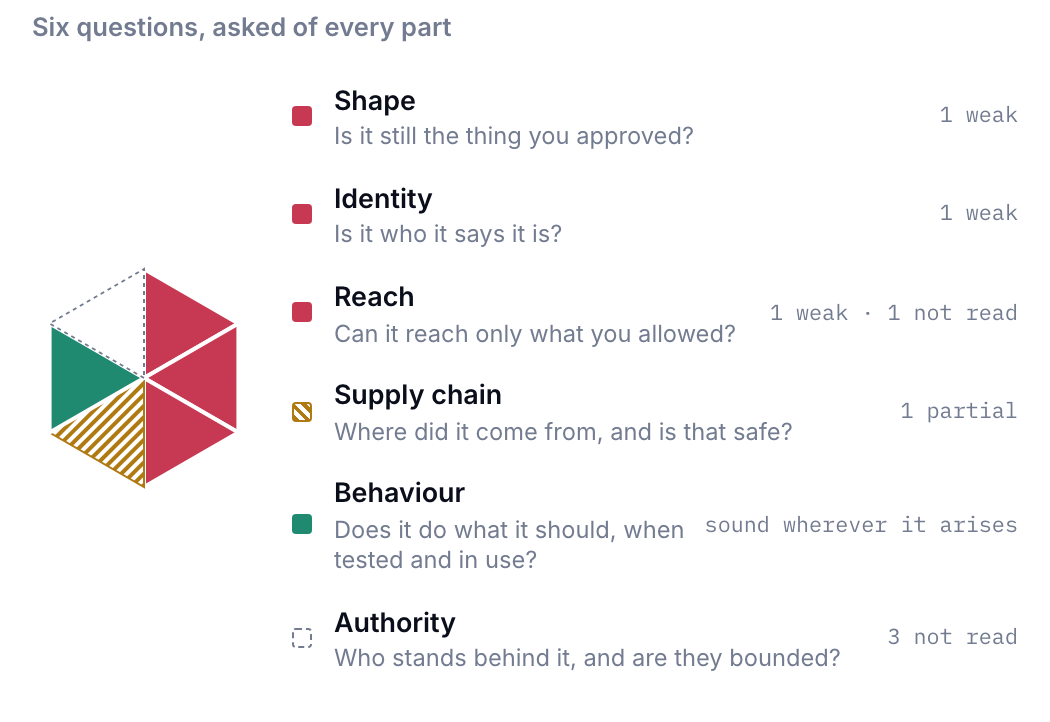
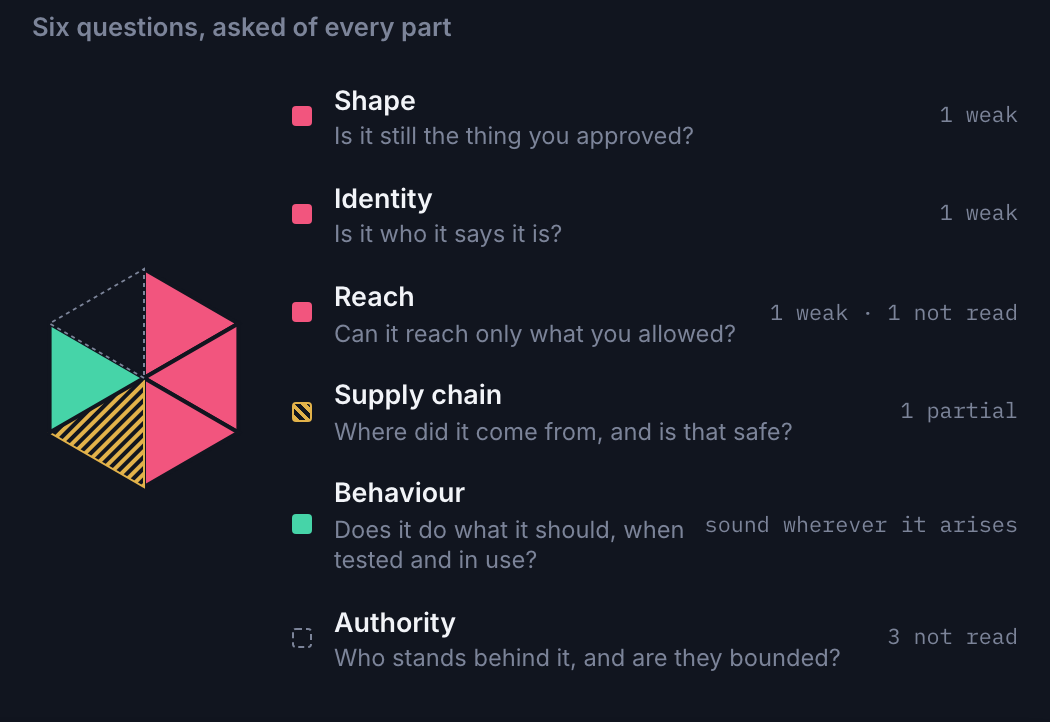
Every part is asked six questions: shape, identity, reach, supply chain, behaviour and authority. An application reads as broken, unapproved, holding weakly or in order.
Autonomous Integrity detects nothing itself. It composes readings other parts of the platform compute, such as MCP tool drift, agent-card checks, probe results and the supply-chain register. Where a question applies and nothing answers it, the page names the gap, and a check the organisation’s plan does not hold is shown as not measured, never as sound.
Six questions, asked of every part
Availability
The weakest-hop rating of each application reached production on 14 September 2026, and the rebuild on 20 September.
Autonomous Integrity is included in Growth, with evidence in Fortress, and is view only or an add-on on Foundation.